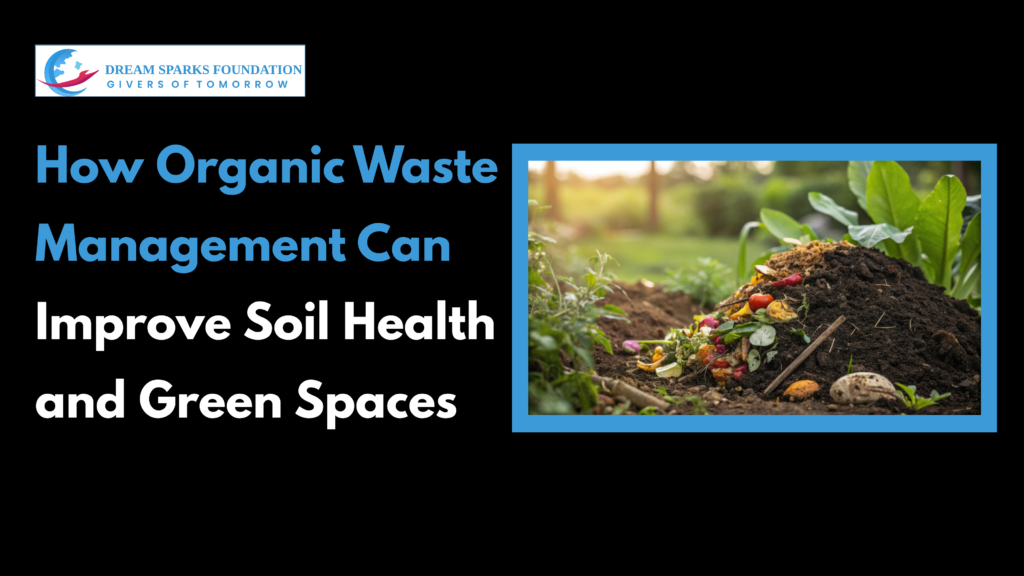
Organic waste is one of the most common forms of waste generated by households, apartments, institutions, restaurants, offices, and communities. Food scraps, fruit and vegetable peels, leaves, grass clippings, and other biodegradable materials can quickly accumulate when they are not managed properly.
Instead of treating organic waste as something that simply needs to be discarded, communities can view it as a valuable resource. Organic composting for soil health is one practical approach that can help transform biodegradable waste into nutrient-rich compost while supporting healthier soil and greener spaces.
Composting connects two important environmental goals: responsible organic waste management and sustainable soil improvement. By keeping suitable organic materials away from landfills and returning nutrients to the soil, composting can contribute to a more circular approach to resource management.
What Is Organic Composting?
Organic composting is the natural process of breaking down biodegradable materials such as food scraps, leaves, grass, and garden waste into a stable, nutrient-rich material called compost.
Microorganisms such as bacteria and fungi break down organic matter under suitable conditions of moisture, oxygen, temperature, and carbon-to-nitrogen balance.
The finished compost can then be used as a soil amendment in gardens, landscaping areas, community green spaces, and agricultural applications.
In simple terms:
Organic waste → Composting → Nutrient-rich compost → Healthier soil → Greener spaces
This makes composting an important part of sustainable waste management practices.
Why Is Organic Waste Management Important?
Organic waste can create environmental challenges when it is poorly managed. Food waste and other biodegradable materials sent to landfills can decompose under conditions that contribute to methane generation.
According to the U.S. Environmental Protection Agency, reducing food waste and recovering organic materials through methods such as composting can help reduce the amount of organic material entering landfills.
Effective organic waste management also reduces the unnecessary disposal of materials that still contain valuable nutrients and organic matter.
Instead of following a linear model:
Consume → Use → Dispose
composting supports a more circular approach:
Consume → Use → Compost → Return nutrients to soil → Grow again
This approach connects food waste and sustainability with soil restoration and green-space development.
Continue reading aboutPrevent Wasted Food Through Source Reduction with this link.
How Does Composting Improve Soil Health?
One of the major benefits of composting is that the resulting compost can improve several physical and biological characteristics of soil.
1. Adds Organic Matter to Soil
Compost adds organic matter that can improve soil structure and provide a source of carbon for soil organisms.
Regularly adding appropriate amounts of compost can help maintain healthier soil in gardens, landscaped areas, and other green spaces.
2. Improves Soil Structure
Healthy soil needs an appropriate balance of air, water, minerals, and organic matter.
Compost can help improve soil structure, particularly when incorporated into soils with low organic-matter content. Better soil structure can support root development and improve the movement of air and water through the soil.
3. Supports Water Retention
Soil enriched with organic matter can have improved water-holding capacity.
This can be particularly useful for gardens and landscaped areas because soil that retains moisture effectively may require less frequent irrigation depending on the soil type, climate, plant selection, and other conditions.
4. Supports Soil Microorganisms
Compost contains organic matter that can support diverse soil biological activity.
Beneficial microorganisms contribute to nutrient cycling and the decomposition of organic materials. A biologically active soil environment can contribute to long-term soil health.
How Does Composting Support Green Spaces?
Healthy green spaces require healthy growing conditions. Parks, gardens, apartment landscapes, institutional gardens, and community planting areas all depend on suitable soil.
Compost can support green-space management by improving soil quality and providing organic matter.
For example, compost can be incorporated into soil before planting, used around established plants as appropriate, or included in landscaping and gardening programs.
This can help communities make better use of locally generated organic resources instead of treating every biodegradable material as disposal waste.
Food Waste and Garden Waste: What Can Be Composted?
Many common organic materials can be composted when managed under suitable conditions.
Common Compostable Materials
- Fruit and vegetable scraps
- Vegetable peels
- Coffee grounds
- Tea leaves
- Leaves
- Grass clippings
- Small amounts of garden trimmings
- Plant residues
- Other suitable biodegradable materials
Composting Food Waste for Beginners
People starting a composting system often wonder where to begin.
A simple approach is to focus on five basic steps:
Step 1: Segregate Organic Waste
Keep food scraps and suitable garden waste separate from plastic, glass, metal, and other non-compostable materials.
Step 2: Choose an Appropriate Composting Method
Depending on the available space and quantity of organic waste, options may include home composting, community composting, aerobic composting, vermicomposting, or other suitable organic waste treatment methods.
Step 3: Maintain the Right Conditions
Composting microorganisms require moisture and oxygen. Too much water can create anaerobic conditions, while excessive dryness can slow decomposition.
Step 4: Balance Different Organic Materials
A mixture of carbon-rich materials such as dry leaves and nitrogen-rich materials such as fresh food scraps can support the composting process.
Step 5: Use Finished Compost Responsibly
Once the compost has matured and stabilized, it can be used appropriately in gardens, landscaping, and other soil-management applications.
Composting Garden Waste: Turning Yard Waste Into a Resource
Garden maintenance can generate significant amounts of leaves, grass, branches, and plant residues.
Without an effective waste management yard waste strategy, these materials may simply be transported away for disposal.
Instead, suitable garden waste can become a valuable input for composting.
Composting yard waste can help communities:
- Reduce organic waste requiring disposal
- Produce useful soil amendments
- Return organic matter to gardens
- Support healthier green spaces
- Reduce the need to transport some biodegradable materials away from their source
A well-planned garden disposal strategy should therefore consider recovery and composting options before disposal.
The Role of Source Segregation
Composting begins before the organic waste reaches a composting system.
It begins at the point where waste is generated.
When food waste is mixed with plastic, glass, metal, or other materials, recovering the organic fraction becomes more difficult.
Source segregation helps create a cleaner stream of biodegradable material and can make downstream processing more effective.
This is why awareness campaigns, clear signage, waste stations, and community participation can be important components of sustainable waste systems.
Organic Composting and Sustainable Waste Management
Modern waste management increasingly focuses on recovering value from waste rather than simply disposing of it.
Organic composting fits into this approach because it can transform biodegradable material into a useful resource.
It can therefore be part of broader sustainable waste management solutions, alongside waste prevention, source segregation, recycling, reuse, and other appropriate recovery methods.
The objective is not simply to move waste from one location to another. It is to manage materials responsibly while reducing environmental impacts and recovering resources wherever practical.
Common Food Waste Issues That Composting Can Help Address
Food waste creates several interconnected challenges, including:
- Increasing quantities of waste requiring management
- Loss of potentially recoverable organic resources
- Pressure on landfill capacity
- Greenhouse-gas emissions associated with landfill decomposition
- Poor source segregation
- Unnecessary transportation of organic waste
- Loss of nutrients and organic matter from local systems
Composting cannot solve every food-waste issue, but it can address an important part of the problem by recovering suitable biodegradable materials.
Organic Composting and a Circular Approach to Waste
Composting demonstrates how a waste stream can become part of a resource cycle.
Consider a simple example:
A residential community generates vegetable peels, fruit scraps, dry leaves, and garden residues.
Instead of mixing these materials with general waste, residents segregate them. Suitable organic materials are then processed through an appropriate composting system. After maturation, the resulting compost can be used in the community’s gardens and landscaped areas.
The nutrients and organic matter return to the soil, supporting new plant growth.
This is a practical example of the circular economy in action.
Conclusion
Organic waste does not always have to end its journey as discarded material.
Through proper source segregation, responsible processing, and organic composting for soil health, food scraps and suitable garden waste can be transformed into a resource that supports soil quality and greener communities.
Composting is most effective when combined with food waste prevention, community participation, sustainable waste-management practices, and responsible resource recovery.
For households, apartment communities, institutions, and organizations, the message is simple:
Segregate organic waste. Compost what can be recovered. Return nutrients to the soil. Grow greener spaces.
By treating organic waste as a resource rather than simply a disposal problem, communities can take practical steps toward cleaner surroundings, healthier soils, and more sustainable waste systems.