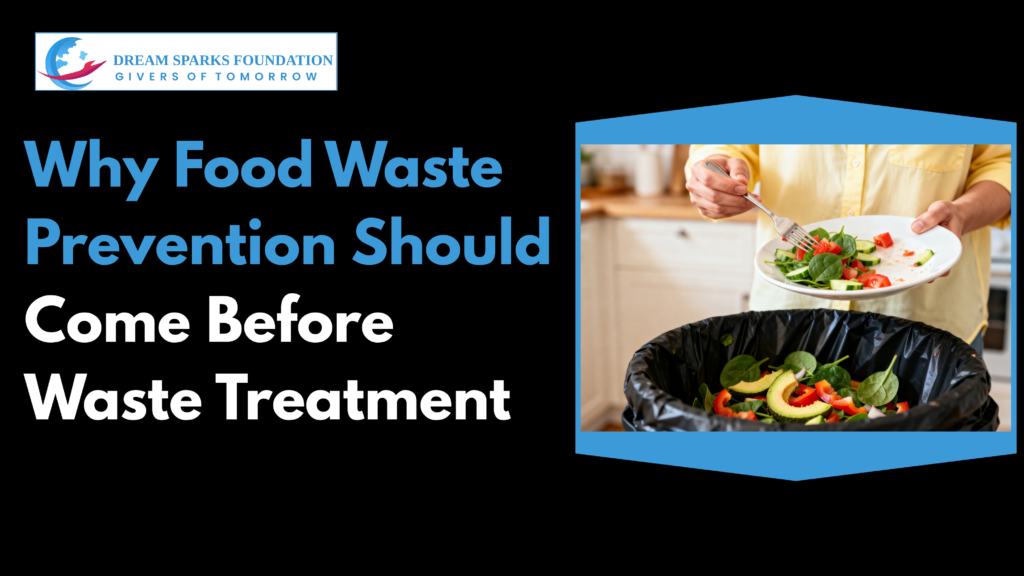
Food is one of the most valuable resources we use every day. It requires land, water, energy, transportation, labour, and many other resources before it reaches our plates. Yet a significant amount of food is never eaten. It may be over-purchased, prepared in excess, stored incorrectly, damaged, or simply left uneaten.
This is why food waste prevention should come before waste treatment.
Waste treatment methods such as composting, organic waste processing, and other recovery solutions play an important role in responsible food waste management. However, the most effective way to deal with food waste is to avoid creating unnecessary waste in the first place.
By focusing on source reduction, households, restaurants, institutions, and communities can save resources, reduce unnecessary disposal, and build more sustainable food systems.
What Is Food Waste Prevention?
Food waste prevention means taking steps to stop edible food from becoming waste.
Instead of asking, “How should we treat this food waste?”, source reduction encourages us to ask, “Why did this food become waste, and could we have prevented it?”
Examples include:
- Buying only the food that is actually needed
- Planning meals before shopping
- Storing food correctly
- Using ingredients before they expire
- Preparing appropriate portions
- Reusing safe surplus food
- Donating suitable surplus food
- Improving inventory management in restaurants
- Educating people about food consumption and waste
These simple actions can help reduce food waste before it enters the waste-management system.
Continue reading about How to Create an Effective Waste Management Plan for Your Business with this link.
Why Should Prevention Come Before Treatment?
Waste treatment is important, but prevention addresses the problem earlier in the process.
Consider a simple example. If a household purchases 10 kilograms of vegetables but regularly throws away 2 kilograms because they spoil, composting those vegetables is better than sending them to a landfill. However, preventing the purchase of those unnecessary 2 kilograms would avoid the waste altogether.
This is the principle behind source reduction.
When food waste is prevented:
- Food remains available for consumption.
- Resources used to produce that food are not unnecessarily wasted.
- Households and businesses can reduce avoidable expenses.
- Less organic waste needs to be processed.
- Waste-management systems can operate more efficiently.
Therefore, treatment should complement prevention rather than replace it.
Food Waste Begins Long Before the Bin
Food waste is not created only when food is thrown into a garbage bin.
Waste can occur throughout the food system—from production and storage to transportation, retail, food preparation, and consumption.
Food can be lost because of:
- Poor storage conditions
- Overproduction
- Transportation damage
- Inaccurate demand forecasting
- Excess purchasing
- Expired products
- Oversized portions
- Food preparation waste
- Consumer preferences
- Uneaten leftovers
Understanding where food loss occurs is essential for developing effective food waste reduction strategies.
Source Reduction Saves More Than Food
Preventing food waste is not simply about keeping food out of the waste bin. It is also about protecting the resources that were used to produce that food.
Food production depends on resources such as:
- Water
- Agricultural land
- Energy
- Fertilizers
- Labour
- Packaging
- Transportation
- Refrigeration
- Processing infrastructure
When edible food is wasted, these resources have been used without providing their intended nutritional value.
This makes food waste prevention an important part of sustainable food production.
The Environmental Impact of Food Waste
Food that is produced but never eaten represents wasted resources across the supply chain. Food waste can also contribute to greenhouse gas emissions through production, transportation, refrigeration, processing, and disposal.
Reducing avoidable food waste can therefore support broader environmental goals.
A practical approach is to follow the principle:
Prevent → Redistribute → Reuse → Recover → Treat → Dispose
The earlier an intervention happens, the more unnecessary waste can potentially be avoided.
What Is the Difference Between Food Loss and Food Waste?
The terms food loss and food waste are often used together, but they can refer to different stages of the food system.
Food loss generally refers to food that is lost during production, harvesting, storage, processing, or distribution.
Food waste is commonly associated with food discarded at retail, food-service, household, or consumption stages.
Both contribute to resource inefficiency and require attention.
Understanding where losses occur makes it easier to identify practical opportunities for prevention.
How Households Can Reduce Food Waste
Households can make a significant difference through everyday habits.
1. Plan Before You Shop
Create a shopping list based on meals you actually intend to prepare. Check your refrigerator, freezer, and pantry before buying additional food.
2. Buy According to Need
Large quantities may appear economical, but purchasing more than your household can consume can result in unnecessary waste.
3. Store Food Properly
Correct storage can extend the usable life of many foods. Organize your refrigerator and pantry so that older products are easier to identify and use first.
4. Use Leftovers Creatively
Instead of automatically discarding leftovers, consider incorporating them into another meal where they remain safe and suitable for consumption.
Food Waste Prevention in Restaurants
Restaurant food waste can occur at several points, including purchasing, storage, preparation, serving, and post-consumer disposal.
Restaurants can implement practical measures such as:
- Monitoring food inventory
- Improving demand forecasting
- Tracking frequently wasted ingredients
- Adjusting portion sizes
- Using ingredients efficiently
- Improving storage systems
- Training kitchen staff
- Creating daily waste-monitoring records
- Managing surplus food responsibly
- Reviewing menus based on actual demand
Measuring food waste is particularly useful because it helps businesses identify where waste is occurring and which processes require improvement.
What Happens When Food Waste Cannot Be Prevented?
Not all food waste can be eliminated.
Peels, cores, bones, spoiled food, and other unavoidable organic materials may still be generated. This is where responsible organic waste management becomes important.
Depending on the material and available infrastructure, organic waste may be directed toward options such as:
- Composting
- Anaerobic digestion
- Other organic waste recovery processes
- Appropriate treatment systems
The objective is to manage unavoidable waste responsibly while continuing to reduce the amount generated at the source.
A Practical Food Waste Reduction Strategy
Organizations and communities can start with a simple five-step approach:
Step 1: Measure
Record how much food is being discarded and where it comes from.
Step 2: Find the Cause
Determine whether waste comes from over-purchasing, poor storage, preparation, portions, expired inventory, or other causes.
Step 3: Prevent
Change purchasing, storage, preparation, and serving practices.
Step 4: Recover
Explore appropriate options for safe surplus food and unavoidable organic material.
Step 5: Monitor
Review the results regularly and make improvements based on actual data.
This creates a continuous improvement cycle rather than treating waste as an unavoidable part of daily operations.
How Communities Can Encourage Food Waste Prevention
Apartment communities, residential associations, schools, offices, and local organizations can encourage better habits through awareness campaigns and practical initiatives.
Simple activities can include:
- Food waste awareness workshops
- Meal-planning campaigns
- Portion-awareness initiatives
- Community composting programs
- Food-sharing or surplus-food initiatives where appropriate
- Waste audits
- Educational posters and digital campaigns
- Regular tracking of organic waste generation
Awareness becomes more effective when people can see measurable results from their actions.
Conclusion
Food waste prevention should come before waste treatment because the most effective waste is often the waste that never gets created.
Composting, organic waste treatment, and resource recovery remain valuable parts of a responsible waste-management system. But they should work alongside source reduction rather than becoming the only solution.
By buying thoughtfully, storing food properly, preparing appropriate quantities, managing surplus food responsibly, and measuring waste, households, restaurants, institutions, and communities can reduce food waste at its source.
Every meal saved from unnecessary waste represents more than food saved. It also represents resources, energy, money, and effort that were not wasted.
For a more sustainable future, the goal should not only be to manage food waste better—it should be to prevent avoidable food waste wherever possible.