Food waste is one of the most overlooked environmental challenges facing communities, businesses, and cities today. Large quantities of food scraps are generated every day from households, restaurants, hotels, institutions, markets, and commercial kitchens. When this organic waste is sent to landfills instead of being properly processed, it can contribute to greenhouse gas emissions, environmental pollution, and the unnecessary loss of valuable nutrients.
One practical solution is composting of food waste. Composting transforms food scraps and other biodegradable materials into nutrient-rich organic matter that can be returned to the soil. Instead of treating food waste as something that must simply be discarded, composting creates an opportunity to recover resources and support healthier ecosystems.
Compost can improve soil structure, support beneficial microorganisms, increase moisture retention, and provide valuable nutrients for plants. For agriculture, landscaping, gardening, and community greening projects, compost can become an important soil amendment while also helping organizations work toward more sustainable waste management.
What Is Composting of Food Waste?
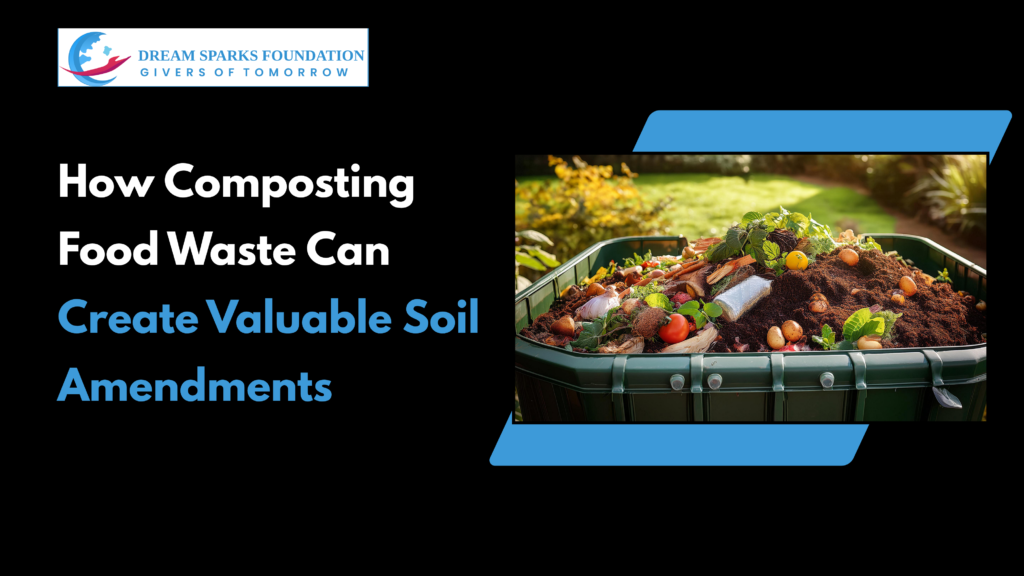
Composting of food waste is the natural or controlled biological process through which microorganisms break down biodegradable food materials and convert them into stable, nutrient-rich organic matter known as compost.
Common food waste materials suitable for composting include:
- Fruit and vegetable scraps
- Vegetable peels
- Food preparation residues
- Coffee grounds
- Tea leaves
- Certain cooked food residues
- Garden and plant residues
- Other biodegradable organic materials
Under suitable conditions, microorganisms break down these materials through biological activity. The process requires an appropriate balance of moisture, oxygen, carbon-rich materials, nitrogen-rich materials, and temperature.
The resulting compost can be used as a soil amendment to improve the physical, biological, and chemical properties of soil.
In simple terms:
Food waste → Composting → Organic compost → Healthier soil → Better plant growth
This circular approach helps keep valuable organic resources within the ecosystem instead of sending them to disposal facilities.
Continue reading about Why We Need to Separate Organic Waste, and What to Do with It with this link
Why Is Food Waste a Growing Environmental Concern?
Food waste is not simply a waste-management problem. It is also connected to agriculture, energy consumption, natural resource use, and climate change.
Producing food requires land, water, energy, transportation, packaging, labor, and other resources. When edible or biodegradable food materials are discarded, many of the resources used to produce them are effectively wasted as well.
Poorly managed organic waste can also create unpleasant odors, attract pests, increase the burden on waste-management systems, and contribute to environmental pollution.
When biodegradable materials decompose without sufficient oxygen in landfill conditions, methane can be generated. Methane is a greenhouse gas that contributes significantly to climate change.
Therefore, better organic waste management can form an important part of broader climate action and sustainability efforts.
How Composting Helps Reduce Food Waste
One of the most direct benefits of composting is that it diverts biodegradable materials away from conventional disposal.
Instead of sending food scraps to landfills, households, businesses, institutions, and communities can collect and process them separately.
1. Diverts Organic Waste From Landfills
Separating food waste at its source reduces the amount of organic material entering landfills.
This can help extend landfill capacity and reduce the environmental challenges associated with large-scale waste disposal.
2. Converts Waste Into a Useful Resource
Composting follows a resource-recovery approach.
Food scraps that were previously considered waste become a useful material that can be returned to the soil.
3. Supports Circular Resource Management
Composting is an example of the circular economy in practice.
Resources are not simply extracted, consumed, and discarded. Instead, organic materials are recovered and returned to productive use.
4. Reduces the Need for Chemical Inputs
Compost can supply organic matter and certain nutrients to soil. When appropriately incorporated into soil-management practices, it can complement other fertility-management approaches.
5. Helps Build Sustainable Communities
Community composting programs, institutional composting, and commercial organic waste processing can encourage people and organizations to take greater responsibility for their waste.
How Compost Enriches Soil
The value of compost goes beyond waste reduction. Properly produced compost can significantly improve soil quality.
Improved Soil Structure
Adding compost can improve soil structure by increasing organic matter. This can help create better conditions for plant roots and soil organisms.
Better Moisture Retention
Organic matter can improve the ability of soil to retain and manage moisture. This can be particularly valuable in areas where water conservation is important.
Increased Organic Matter
Healthy soils depend on organic matter. Compost contributes organic material that can support long-term soil health.
How Composting Can Help Reduce Carbon Footprints
Businesses, institutions, residential communities, and municipalities increasingly want to understand how their operations affect the environment.
Food waste management can be one component of a broader strategy for reducing carbon footprint.
Composting can contribute by:
- Diverting organic waste from landfill
- Recovering nutrients
- Reducing the volume of waste requiring disposal
- Supporting local soil improvement
- Encouraging resource recovery
- Promoting sustainable waste-management practices
Organizations can combine composting with other climate-conscious initiatives such as energy efficiency, renewable energy, water conservation, sustainable procurement, and waste prevention.
The Role of a Waste Composter
A waste composter can help organizations process biodegradable waste in a controlled and efficient manner.
Depending on the technology and scale, composting systems can be designed for residential communities, institutions, restaurants, hotels, commercial facilities, agricultural operations, and other organizations that generate significant quantities of organic waste.
A suitable composting system can help organizations:
- Segregate organic waste at the source.
- Process biodegradable material under controlled conditions.
- Reduce the amount of organic waste sent for disposal.
- Produce compost or stabilized organic material.
- Reuse the resulting material where appropriate.
- Monitor and improve their waste-management practices.
The right system depends on factors such as waste quantity, available space, material composition, operational requirements, moisture levels, processing time, and intended use of the final product.
Composting of Food Waste in Homes and Communities
Composting does not have to be limited to large commercial facilities.
Households can compost suitable kitchen and garden waste using home composting systems. Communities can also establish decentralized composting programs where organic waste is collected and processed closer to where it is generated.
Community-level composting can provide several benefits:
- Less organic waste transported long distances
- Greater community participation
- Local production of soil amendments
- Increased environmental awareness
- Better source segregation
- Support for community gardens and landscaping
Educational initiatives can make an important difference by teaching residents what materials can be composted and how to separate them correctly.
Composting and Sustainable Farming Practices
Composting works particularly well when combined with other sustainable farming practices.
Farmers can incorporate compost into broader soil-management programs designed to maintain soil fertility and reduce resource losses.
For example, compost can be used alongside cover crops to increase organic matter, mulching to reduce evaporation, crop rotation to improve soil management, and efficient irrigation to conserve water.
These approaches can help agriculture become more resilient to some of the pressures associated with the climate change impact on agriculture, including changing rainfall patterns, soil degradation, and water stress.
However, compost alone cannot solve every agricultural or environmental challenge. It should be considered one component of an integrated sustainability strategy.
Conclusion
The composting of food waste offers a practical way to address two important environmental challenges at the same time: organic waste management and soil degradation.
Instead of allowing food scraps to become a disposal burden, composting can transform them into valuable organic matter that supports healthier soils and more sustainable resource use.
The benefits extend beyond waste reduction. Compost can contribute to soil health, sustainable agriculture, resource recovery, water management, and broader environmental goals. When combined with food waste prevention, source segregation, responsible consumption, and other sustainable practices, composting can become an important part of a circular approach to environmental management.
For households, communities, farms, businesses, and institutions, the message is simple: